


Pengumuman Kedubes

- Tentang Kedubes
- Pengumuman Kedubes
- Font Size
-


JOINT STATEMENT ON THE ESTABLISHMENT OF A SPECIAL COMPREHENSIVE STRATEGIC PARTNERSHIP BETWEEN THE REPUBLIC OF KOREA AND THE REPUBLIC OF INDONESIA
- DATE
- 2026-04-10
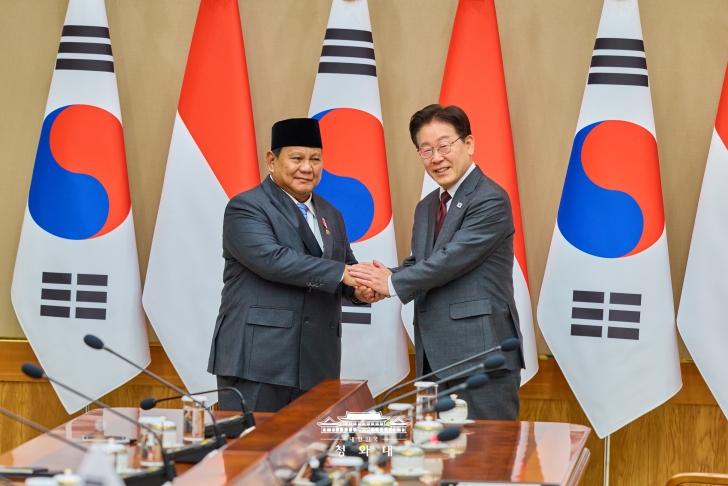
1. At the invitation of the President of Republic of Korea His Excellency Lee Jae Myung, the President of the Republic of Indonesia His Excellency Prabowo Subianto, paid a state visit to Korea from 31 March to 1 April 2026. On the occasion of this state visit, the two Leaders announced the elevation of the Special Strategic Partnership to the level of a Special Comprehensive Strategic Partnership (SCSP) for inclusive growth and shared prosperity for future.
2. The two Leaders highly commended the deepening and expansion of the bilateral relationship across a broad range of areas, including diplomacy and security, the economy, culture, people-to-people exchanges, as well as regional and international issues, since the establishment of diplomatic relations in 1973, in line with the establishment of the Strategic Partnership in 2006 and the Special Strategic Partnership in 2017, and noted that the partnership between the ROK and RI made significant contributions to regional and global peace, stability, and prosperity.
3. Building upon the foundation of friendship and cooperation developed between the two countries, the two Leaders affirmed that the Special Comprehensive Strategic Partnership would place greater emphasis on concrete and forward-looking cooperation, encompassing both existing and new areas of common interest, for the benefit of the two nations as well as the wider region and the international community, while upholding the values shared by both countries, such as democracy, multilateralism, and the rule of law.
4. In this context, the two Leaders expressed their resolve to work closely together across the following five pillars, with a view to advancing their shared vision of a stronger, more prosperous and more innovative ROK-RI partnership that enhances the welfare and well-being of their peoples.
I. Political and Security Cooperation
5. The two Leaders pledged to further invigorate high-level exchanges between the two countries, support parliamentary exchanges, and expand communication and exchanges at all levels and across all sectors of their governments, where possible on a regular basis, in order to deepen mutual understanding and trust.
5.1. The Leaders entrusted their Foreign Ministers with the establishment of a new bilateral strategic dialogue mechanism – Special Comprehensive Strategic Dialogue (SCSD) – to coordinate and oversee cooperation across various fields, and underscored their commitment to convene the Dialogue on an annual basis through the MOU on establishing the SCSD. The SCSD will coordinate with other bilateral mechanisms for cooperation between the two countries. The SCSD will be supported through the following vice-ministerial consultative dialogue mechanisms as follows:
5.2. Building on the legacy of the High-Level Dialogue on investment (HLDI), the Strategic Economic Dialogue (SED) is intended to provide a structured platform for strategic economic and investment cooperation, which will be co-chaired by Vice Minister of Foreign Affairs and Vice Minister of Finance and Economy of ROK and Vice Minister of Foreign Affairs and Vice Minister of Investment and Downstream Industry of RI and participated from related ministries and private sectors.
5.3. Strategic Maritime Dialogue (SMD) will be led by Vice Minister of Ocean and Fisheries of ROK and Vice Minister of Foreign Affairs of RI, and address broader strategic and security aspects of maritime cooperation, ensuring a comprehensive approach that extends beyond purely economic and sectoral matters.
6. The two Leaders underscored the importance of strategic communication in order to safeguard national security and maintain regional stability, and committed to further expanding cooperation in national defense and security.
6.1. The Leaders agreed to invigorate the ROK-RI Foreign Affairs and Defense Senior Officials’ Meeting (2+2) with the aim of elevating it to the ministerial level. Both Leaders expressed their commitment to holding the ROK-RI Defense Ministers’ Meeting, and utilizing opportunities such as the ASEAN-related Defence Ministers’ Meeting (ADMM) Plus in order to further revitalize high-level and working-level exchanges between the defense ministries and armed forces of the two countries.
6.2. The Leaders underscored both nations’ unwavering commitment to further expanding cooperation in the defense industry, symbolizing the highest level of strategic trust between the two countries, including capacity-building, research and development, and joint production, and committed to the continued annual ROK-RI Defense Industry Cooperation Committee, co-chaired by the Minister of the Defense Acquisition Program Administration of the ROK and the Secretary General of the Ministry of Defense of the RI.
6.3. The Leaders noted with satisfaction that the joint development of the KF-21/IF-X fighter aircraft, which has been underway for over 10 years between the two countries, is scheduled for completion in June 2026, and expressed their commitment to cooperation on the IF-21 production project and their expectations for the continued progress of other defense industry cooperation projects, including collaboration on trainer aircrafts anti-tank guide missile (ATGM) systems, and ammunition.
7. Reiterating the importance of the bilateral cooperation in non-traditional security issues which directly affect the lives of the people, the two Leaders expressed their commitment to strengthen their cooperation in areas such as counterterrorism, responses to transnational crime, as well as maritime security and safety cooperation and forest fire prevention and response. Both Leaders welcomed the signing of the MOU on Forest Fire Management and Post-Fire Restoration Cooperation and the Framework Arrangement concerning Cooperation on Priority Program in the Field of Forestry and the forthcoming signing of MOU on Counter-Terrorism Cooperation as well as the future revision of the MOU on Police Cooperation.
II. Trade, Investment and Industry Cooperation
8. The two Leaders recognized that economic cooperation has been a driving force behind mutually beneficial relations between the two countries, and pledged to further strengthen cooperation to promote private-sector economic cooperation in both countries. Both Leaders also committed to encouraging increased two-way investment, including quality investment that supports value creation and knowledge sharing for mutual benefit as well as expanding bilateral trade volume while emphasizing the importance of creating a stable, favorable and predictable business environment for companies.
8.1. President Lee Jae Myung appreciated President Prabowo Subianto’s attention and efforts in supporting Korean companies’ growth in Indonesia, including in addressing challenges, and expressed hope for continued cooperation going forward. The Leaders reaffirmed the importance of enhancing transparency, strengthening technical consultations, and promoting regulatory cooperation to facilitate trade and investment. The Leaders also expressed their commitment to strengthening dialogue among relevant authorities, including on matters related to standards, technical regulations and conformity assessment procedures with a view to enhancing predictability and further promoting trade and investment growth.
8.2. The Leaders underscored the need for close cooperation to further expand the bilateral trade volume and investment flows by fully utilizing the ROK-RI Comprehensive Economic Partnership Agreement (CEPA), which entered into effect in January 2023, and to further facilitate its wider utilization by businesses and effective implementation through the regular convening of meetings of the ROK-RI CEPA Joint Committee and its subcommittees.
8.3. The Leaders welcomed the signing of the MOU on Economic Cooperation 2.0 aimed at strengthening government-to-government communication, and expanding cooperation in trade and investment, the digital economy, and the industrial and resources sectors and reaffirmed their commitment to the annual convening of the ROK-RI Joint Committee on Economic Cooperation between the Minister of Trade, Industry and Resources of the ROK and the Coordinating Minister of Economic Affairs of the RI, and to convening the 3rd Committee Meeting before the end of the year of 2026.
8.4. The Leaders expressed their commitment to strengthen cooperation in the areas such as Halal certification and intellectual property for promoting trade and facilitating market access, and welcomed the signing of the MOU on Intellectual Property Protection and Enforcement Cooperation.
8.5. The Leaders welcomed the signing of the MOU between the Export-Import Bank of Korea, and Indonesia’s Danantara Investment Management for mutually beneficial investment cooperation. President Lee appreciated Danantara Indonesia’s exploration of active investment opportunities in Korea.
8.6. The Leaders expressed their intention to continue strengthening existing cooperation and to further enhance new cooperation in areas of mutual interests such as transportation infrastructure, smart cities, and construction, and welcomed the signing of the MOU between Korea Overseas Infrastructure & Urban Development Corporation and Indonesia’s Danantara Investment Management to strengthen the strategic cooperation in this field.
9. The two Leaders expressed their strong commitment to enhance cooperation in strategic economic sectors that contribute to mutual economic growth and long-term development of both countries, including advanced manufacturing, automobiles (including electric vehicle and battery ecosystem), steel, machinery, semiconductors, critical mineral and rare earth elements, shipbuilding and maritime industry.
9.1. The Leaders reaffirmed their commitment to further cooperation in fostering the electric vehicle ecosystem in RI and promoting the production of Indonesian-made batteries, and committed to strengthening the policy environment including the Local Content Ratio (TKDN) scoring system for electric vehicles consistent with applicable laws and regulations, as well as enhancing cooperation in battery recycling to promote circularity and strengthen the sustainability of the EV supply chain.
9.2. The Leaders acknowledged the essential role of securing critical mineral supplies for the development of advanced industries, welcomed the renewal of the MOU on Cooperation in Critical Mineral Partnership, and expressed their determination to strengthen cooperation to stabilize critical mineral supply chains.
9.3. The Leaders committed to cooperating to enhance their competitiveness of the shipbuilding and maritime industry and to further elaborating cooperation in areas such as human resources development and MRO industry.
9.4. The Leaders reaffirmed their commitment to positioning the maritime and fisheries sectors as key drivers of growth, and to prioritizing innovation in the Blue Economy, including through conducting joint research in marine biotechnology, utilizing AI and big data for maritime resource monitoring, developing advanced ocean disaster early warning systems, strengthening sustainable capture and aquaculture fisheries based on cutting-edge science and technology, accelerating downstream industrialization and robust cold chain systems, enhancing maritime logistics and port connectivity for fisheries infrastructure, advancing quality standardization, digital traceability, the harmonization of Sanitary and Phytosanitary (SPS) measures and developing smart aquaculture innovation. Furthermore, both leaders expressed their intention to strengthen maritime human resource development through specialized technical training and vocational education to support the integrated transition to a green and blue economy.
10. The two Leaders welcomed the ongoing and future sister schools program and exchanges between students of high schools including technical and vocational education and training institutions and technical college in the two countries, and committed to working together to explore ways to provide technical and vocational education and training opportunities for Indonesian youth through public TVET institutions in the ROK.
11. The two Leaders acknowledged the importance of micro, small and medium-sized enterprises (MSMEs) to the national economy, and welcomed a future renewal of the MOU concerning Cooperation in the Development of Micro, Small and Medium Enterprises and Startups, which is expected to help expand market access, strengthen capacity building, and support innovation among MSMEs and startups.
12. The two Leaders emphasized the importance of enhancing cross-border payment connectivity to strengthen financial resilience and promote trade and investment between ROK and RI, the two Leaders announced the launch of the Cross-Border QR Payment Linkage implementation between the two countries starting in April 2026, which aims to enhance transaction efficiency, lower costs, strengthen financial resilience, and promote inclusive growth, especially for MSMEs and tourism.
13. The two Leaders affirmed their commitment to making joint efforts toward the conclusion of the Framework Agreement for Grant Aid between the Government of the ROK and the Government of RI, with a view to facilitating the smoother implementation of development cooperation projects between the two countries. Both Leaders underscored the importance of strengthening bilateral cooperation in human resources development and welcomed a forthcoming renewal of the MOU on the World Friends Korea (WFK) Program, implemented through the Korea International Cooperation Agency (KOICA). This program will continue supporting Indonesia’s capacity-building in priority sectors through the deployment of Korean volunteers, while fostering closer people-to-people ties.
III. Advanced Technology, Energy Transition and Green Economy Cooperation
14. The two Leaders recognized that AI is a universal right shared by all, rather than a privilege of a specific group, and announced the “Global AI Universal Basic Society (AI-UBS) Solidarity Initiative”, designed as a forward-looking and transformative framework where the fundamental rights of every individual are actively realized. Grounded in a human-centered approach, the initiative champions safety, ethics, and well-being, to ensure technology remains inclusive and equitable. By integrating their AI ecosystems, they aim to address global challenges in healthcare, education, food security, government, and other strategic sectors.
14.1. The Leaders welcomed the signing of the MOU on Cooperation on AI for Basic Health and Human Development. The Leaders looked forward to strengthening health cooperation between the two countries and expanding its scope to new areas such as digital healthcare based on AI, building on existing cooperation.
14.2. The Leaders welcomed the signing of the MOU on Cooperation in Digital Development, which is expected to promote, among others, cooperation in AI and information and communication technology fields, including through the newly launched ROK-RI ICT Cooperation Joint Committee.
14.3. The Leaders welcomed a future renewal of the MOU on Educational Cooperation and reaffirmed their shared commitment to strengthening collaboration in STEM education, AI, literacy and numeracy, vocational education, digital wellness and the professional development of educators.
14.4. The Leaders recognized the need to strengthen the cooperation in the fields of AI in Government, including AI and Emerging Technologies, for public sector to exchange knowledge and experiences for development on AI in Government and agreed to pursue follow-up discussions with the aim of the timely conclusion of an MOU between the Ministry of the Interior and Safety of the Republic of Korea and the Ministry of Administrative and Bureaucratic reform of the Republic of Indonesia. This enables ROK and RI to establish a foundational framework for cooperative initiatives in Digital Government through the Digital Government Cooperation Center (DGCC).
14.5. The Leaders welcomed the ongoing collaboration on digital transformation, including initiatives currently underway between KOICA of the Republic of Korea and the Ministry of State Secretariat of the Republic of Indonesia. The partnership is designed to strengthen the digitalization of government processes, enhance the digital skills of officials, and improve the efficiency, responsiveness, and overall effectiveness of public administration.
14.6. The Leaders expressed their expectations for an early conclusion of the MOU on Cooperation in the Area of Disaster and Safety Management within the year, which will lead to the expansion of cooperation in the field of disaster management, including through utilizing new technologies.
14.7. President Prabowo welcomed the Korean Government’s readiness to cooperate in strengthening Indonesia’s food security, including by the promotion of research based on innovative technologies such as AI and digital technologies through ROK-RI Rice Innovation Center and by supporting efforts to increase grain productivity, and enhance collaboration in the food and agricultural sector. In this regard, both Leaders reaffirmed their commitment to strengthening cooperation, including by reinforcing foundational systems such as research and innovation in seed development.
15. Acknowledging both countries’ respective technological strengths and the opportunities and benefits of frontier technologies, the two Leaders committed to further expanding cooperation and promoting exchanges in the field of data and statistics, High-Performance Computing system, information and communication technology.
15.1. The Leaders reaffirmed that data and statistics are essential for evidence-based policymaking and welcomed the signing of the MOU Concerning Cooperation in Data and Statistics, which will lead to the use of well-measured statistics in economic, social and environmental matters
15.2. The Leaders appreciated the ongoing cooperation between the Korean Government and the Indonesian National Research and Innovation Agency (BRIN) to strengthen digital capabilities and advance data and AI application in RI through developing High-Performance Computing (HPC)-based environment by providing advanced HPC infrastructure and capacity-building, and expressed their expectations for its contribution to the development of HPC system in RI.
15.3. The Leaders welcomed the signing of the MOU on Development Cooperation. Building on this MOU, they shared the view that both sides would work closely to advance cooperation in technology, digitalization, and innovation, while also supporting efforts to strengthen health resilience, climate resilience, energy access, and other areas to be mutually determined by ROK and RI, in accordance with their respective competencies.
16. Recognizing that the climate crisis is becoming a reality, the two Leaders emphasized the need of cooperation in responding to climate change, including fulfilling climate commitments, and committed to strengthening cooperation in the field of energy transition and green economy.
16.1. The Leaders recognized that the energy transition is essential for achieving carbon neutrality, and affirmed the importance of strengthening cooperation to achieve a practical and balanced energy mix, and to expand new and renewable energy and nuclear energy through bilateral cooperation or by exploring opportunities for cooperation with leading nuclear partners. The Leaders also expressed their expectation of expanded cooperation in the field of waste-to-energy.
16.2. The Leaders noted the MOU on cooperation in the field of clean energy aims to strengthen diverse forms of comprehensive cooperation to accelerate the energy transition on the basis of the principles of mutual benefit, equality and reciprocity. The two Leaders welcomed the signing of the MOU on cooperation in the field of Carbon Capture and Storage (CCS) and reaffirmed their commitment to strengthening cooperation through the establishment of a framework for knowledge sharing and exchange activities, as well as the exploration of future opportunities for cooperation, including transboundary CCS and implementation of Article 6 of the Paris Agreement.
16.3. The Leaders pledged to accelerate efforts to promote a high-level Energy Resources Security Dialogue and regular public-private cooperation channels for policy exchange and the identification of cooperative projects in the energy and resource sectors, underscoring the importance of maintaining stable, open, and reliable global energy supply chains, and minimizing disruption to the flow of energy and essential goods.
16.4. The Leaders reaffirmed their commitment to enhancing cooperation on the decommissioning and re-utilization of post-operational offshore oil and gas platforms in a carbon-neutral and environmentally friendly manner. The Leaders also expressed their commitment to promoting exchanges between the public and private sectors, strengthening the capacity of the offshore oil and gas platform service industry, and developing related human resources through the signing of the MOU on Cooperation in the Field of Offshore Plant Service Industry.
IV. Socio-Cultural Cooperation and People-to-People Exchange
17. The two Leaders underscored the importance of cultural exchange for promoting mutual understanding and friendship between the two peoples, and reaffirmed their commitment to strengthening cooperation in the cultural and creative industries, including the establishment and operation of the High-Level Creative Industry Cooperation Committee between the Ministry of Culture, Sports and Tourism (MCST) of the ROK and the Ministry of Creative Economy of RI, and the implementation of joint projects in the cultural and creative industries.
18. The two Leaders highly appreciated that labor cooperation between the two countries has delivered mutually beneficial outcomes for both countries and committed to continuing efforts to expand relevant cooperation. The Leaders also pledged to continue strengthening cooperation to uphold the principle of fair and ethical recruitment and to ensure that Indonesian workers in the ROK can work in a healthy and safe environment while complying with the domestic laws and regulations of both countries, including those governing the period of stay.
19. The two Leaders reaffirmed their commitment to further strengthening cooperation in the field of education to foster global talent who will lead future society.
19.1. The Leaders welcomed the provision of the Global Korea Scholarship (GKS) for Indonesian recipients, which has reached up to 1,126 awardees from 1969, and noted the successful implementation of the program. They further welcomed the Korean Government’s plan to increase the share of STEM students among GKS recipients, and expressed their expectation that the participation of outstanding Indonesian students pursuing studies in STEM fields will continue to expand in the future.
19.2. The Leaders reaffirmed their commitment to deepening ROK-RI cooperation in teacher capacity building, encompassing professional development, digital learning innovation, and curriculum enhancement. They highlighted the importance of sustained partnerships, exchange programs, and knowledge sharing to empower educators and enhance the quality of education in both countries.
20. The two Leaders were pleased to note that approximately 860,000 people from both countries visited each other in 2025, reaching a record high in people-to-people exchanges, and expressed their intention to explore ways to further promote such exchanges between the two countries, including through reciprocal facilitation of visit visas, and welcomed the establishment of Immigration Dialogue between two countries.
20.1. The Leaders recognized tourism as a key driver of economic growth, cultural exchange, and people-to-people connectivity, and committed to strengthening cooperation in the tourism sector through enhanced promotional activities and support for joint tourism marketing initiatives.
20.2. The Leaders underscored the pressing need to revitalize exchanges among next-generation leaders to foster a future-oriented friendship between the two countries, and supported the revival of ROK-RI Young Leaders’ Dialogue.
21. The two Leaders highlighted their commitment to continue to strengthen consular cooperation, including holding of the ROK-RI Consular Consultation to ensure the safety and convenience of their respective nationals visiting or residing in each other’s countries.
V. Regional and Global Cooperation
22. President Prabowo appreciated the ROK’s steadfast support for ASEAN Centrality, the ASEAN Community Vision 2045 and its Strategic Plans, and the ASEAN Outlook on the Indo-Pacific (AOIP), and welcomed the ROK’s intention to host an ASEAN-ROK Commemorative Summit in 2029. President Prabowo further took note of, and expressed appreciation for, President Lee’s ROK-ASEAN CSP (Contributor, Springboard, Partner) vision announced at the 26th ASEAN-ROK Summit in 2025, and the two Leaders agreed to work closely together to strengthen meaningful, substantive and mutually beneficial ASEAN–ROK cooperation.
23. The two Leaders commended the contribution of ROK-BIMP-EAGA sub-regional cooperation to promoting inclusive and sustainable economic growth and development and shared prosperity in the region, and underscored the need to continue strengthening cooperation to narrow development gaps and enhance connectivity within the framework of ROK-BIMP-EAGA.
24. The two Leaders further committed to strengthening regional cooperation to address transnational crime of shared concern, particularly through the ASEAN Ministerial Meeting on Transnational Crime (AMMTC) and ASEANAPOL mechanisms.
25. The two Leaders further committed to supporting the enhancement of regional security architecture through advancing the ARF’s evolution toward preventive diplomacy while continuing to strengthen confidence-building measures.
26. The two Leaders reaffirmed their steadfast support for multilateralism and remained committed to closely cooperating and strengthening mutual support in international and regional forums in which both countries participate, such as the UN, WTO, APEC, ASEAN, ASEAN Plus Three, EAS, ARF, and G20, as well as MIKTA. President Prabowo congratulated the ROK on the successful hosting and outcomes of the 2025 APEC Economic Leaders’ Meeting, and President Lee expressed his strong support for RI’s efforts toward accession to the OECD and pledged to continued support through the sharing of experience.
27. The two Leaders reiterated the need to maintain peace, stability and freedom of navigation in and overflight above the South China Sea, in accordance with international law, including the 1982 United Nations Convention on the Law of the Sea (UNCLOS). The two Leaders also reaffirmed the importance of the peaceful resolution of disputes in accordance with international law, including the 1982 UNCLOS.
28. The two Leaders reaffirmed their commitment to the complete denuclearization of the Korean Peninsula and to lasting peace and stability in the region. President Prabowo expressed his support for the ROK’s efforts to achieve peaceful coexistence and shared growth on the Korean Peninsula through the expansion of inter-Korean exchanges, normalization of relations, and progress toward denuclearization. President Prabowo also reaffirmed RI’s commitment to actively cooperate toward these goals at both bilateral and multilateral levels.
29. President Prabowo expressed his deep gratitude for the warm hospitality and courtesy extended by President Lee and the people of ROK, and cordially invited President Lee and his spouse to pay a state visit to RI at an appropriate time. President Lee expressed his gratitude and graciously accepted the invitation. The two Leaders agreed to continue discussions on issues of mutual interest on various occasions, with a view to further developing the ROK-RI Special Comprehensive Strategic Partnership.

- Kedutaan Besar Republik Korea untuk Republik Indonesia
- Address : Jl. Jendral Gatot Subroto Kav.57 Jakarta 12950
- Tel : 62-21-2967-2555 | Hari Senin~Hari Kamis - 09:00~12:00, 13:00~17:00 / Hari Jumat - 09:00~11:30, 13:00~17:00